


Farmers of India
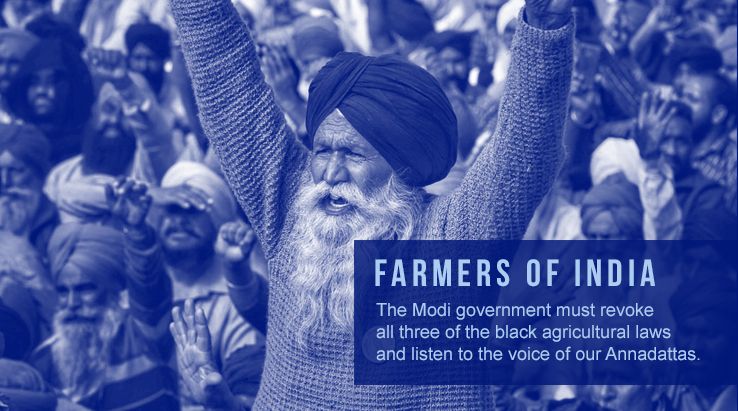
The Indian National Congress Party has always been fighting for the rights of farmers and working to empower them. Even today, INC is standing with the farmers, shoulder-to-shoulder, who are protesting against the three black laws unconstitutionally passed by the BJP government – the Farmers Produce Trade and Commerce (Promotion and Facilitation) Act, 2020, The Farmers (Empowerment and Protection) Agreement on Price Assurance and Farm Service Act, 2020, and The Essential Commodities (Amendment) Act, 2020.
While the BJP government relentlessly fights against the farmers, calling them “Khalistani,” refusing to repeal the 3 black laws or even acknowledging the death of a large number of hardworking farmers in the protest, the Congress government has sworn to stand by our Annadatas.
Congress leader Rahul Gandhi has also vigorously backed the farmers who are protesting against the contentious farm laws brought by the Centre. He said, “No government in the world can stop farmers fighting the battle of truth. The Modi government will have to agree to their demands & take back the ‘black laws.’
Major Issues with the 3 Bills –
- Abolishing the system of Grain Market-Vegetable Market i.e. APMC will totally destroy the ‘Agriculture Produce Procurement System’.
a. In such a scenario, the farmers will neither get the ‘Minimum Support Price’ (MSP) nor the price of their crop as per the market price.
- Farmers get remunerative prices for their produce near their agricultural fields at grain market-vegetable market through community organisation of farmers and mutual competition among the customers in the markets. In the market, predetermined ‘Minimum Support Price’ (MSP) is the benchmark to decide the price of agriculture produce. This is the only measure for the ‘Price Discovery’ i.e. price determination for the farmer’s produce on the community basis. Grain-Vegetable Market System is the guarantee of fair prices, accurate weight and sale of farmer’s produce.
a. If the farmer’s crop instead of being sold in the market on Community Purchase basis, is purchased at the agriculture field itself, in that case the farmer will lose the power of price determination, weight and bargaining for prices. Thus, the farmer will suffer the losses.
- The Modi Government’s claim, that now the farmer can sell his produce anywhere in the country, is a white lie. Even today, the farmer can sell his produce in any state.
a. As far the agriculture census 2015-16, 86 per cent of farmers in the country own less than 5 acres of land. Average land holding is 2 acres or less than that.
b. In such a situation, 86 percent of farmers cannot transport or ferry their farm produce to other places, but have to sell at the nearest grain market-vegetable market. In the event of the Mandi System getting abolished, it will lead to a huge blow for farmers.
- The abolition of the Mandi System shall snatch away the means of bread and butter and livelihood of the millions of labourers, commission agents, loaders, transporters, sellers etc.
- Scrapping the Grain-Vegetable Market System will diminish the source of income of the states.
a. States through its earning from ‘Market Fees’ and ‘Rural Development Fund’ undertake infrastructure development in rural areas and incentivise agriculture.
- Agriculture experts believe that under the garb of the ordinance, the Modi Government actually intends to implement the ‘Shanta Kumar Committee Report’ so that the Government is not compelled to make procurement at Minimum Support Price (MSP) through FCI and thereby save an amount of around Rs. 1 lakh crores annually. This will directly lead to an adverse effect on the agriculture sector.
- Through this ordinance, there is an intention to render the farmer merely a labourer in their own lands by getting him entangled in the contract system. Does a poor farmer with 2-5 acres of land holding will be able to frame, understand and sign a sale-purchase contract with big companies?
- Totally lifting the stock limit on the agriculture produce, consumable items and fruit-flower-vegetables shall neither benefit farmers nor the consumer. It will only benefit a handful of people indulging in hoarding and black marketing. They will be able to purchase at cheaper prices and then sell at higher prices after holding the stocks of these items legally,
- In the ordinances, there is neither any provision for the protection of labourers rights nor for the protection of the rights of the persons, who are engaged in agriculture taking land on rent or on produce sharing basis.
- These three ordinances are the direct attack on the federal structure of the country. ‘Agriculture and Mandis’ come under the purview of the State Governments under the 7th Schedule of the Constitution, but the Modi Government didn’t take the state Governments in confidence on this issue.
Main demands of the Congress Party Congress demands that Modi ji should stop cheating and conspiring against our farmers and leave ego and prejudice aside. The government must talk to our annadatas directly, with an open mind to end these three anti-farmer black laws.
Demands of the Congress Party –
- The government should revoke these laws, call a session of Parliament and discuss whether they want to bring reforms. If they are working in the interest of the farmers, then they will welcome this.
- The Prime Minister, Shri Narendra Modi, should immediately declare to suspend the three anti-farming black laws.
- The Prime Minister, Shri Narendra Modi himself, who publicly in Mann ki Baat said that these three black laws are right, and the Chief Minister of Haryana, Mr. Manohar Lal Khattar, for calling farmers terrorists should apologize.
- Prime Minister, Shri Narendra Modi himself should speak to the delegation of the millions of farmers who are sitting around Delhi.
- Announce the immediate withdrawal of 12 thousand FIRs vis-a-vis burning of stubble against farmers without any condition.
- If they want to improve these laws, then they should bring a fourth law, make MSP mandatory and make it punishable if someone does not adhere to MSP.
The BJP government should finally show empathy towards our annadatas, repeal the three laws and provide legal guarantee of MSP to farmers, the same way they have provided services to their suit-boot friends.
The Indian National Congress Party has always been fighting for the rights of farmers and working to empower them. Even today, INC is standing with the farmers, shoulder-to-shoulder, who are protesting against the three black laws unconstitutionally passed by the BJP government – the Farmers Produce Trade and Commerce (Promotion and Facilitation) Act, 2020, The Farmers (Empowerment and Protection) Agreement on Price Assurance and Farm Service Act, 2020, and The Essential Commodities (Amendment) Act, 2020.
While the BJP government relentlessly fights against the farmers, calling them “Khalistani,” refusing to repeal the 3 black laws or even acknowledging the death of a large number of hardworking farmers in the protest, the Congress government has sworn to stand by our Annadatas.
Congress leader Rahul Gandhi has also vigorously backed the farmers who are protesting against the contentious farm laws brought by the Centre. He said, “No government in the world can stop farmers fighting the battle of truth. The Modi government will have to agree to their demands & take back the ‘black laws.’
Major Issues with the 3 Bills –
- Abolishing the system of Grain Market-Vegetable Market i.e. APMC will totally destroy the ‘Agriculture Produce Procurement System’.
a. In such a scenario, the farmers will neither get the ‘Minimum Support Price’ (MSP) nor the price of their crop as per the market price.
- Farmers get remunerative prices for their produce near their agricultural fields at grain market-vegetable market through community organisation of farmers and mutual competition among the customers in the markets. In the market, predetermined ‘Minimum Support Price’ (MSP) is the benchmark to decide the price of agriculture produce. This is the only measure for the ‘Price Discovery’ i.e. price determination for the farmer’s produce on the community basis. Grain-Vegetable Market System is the guarantee of fair prices, accurate weight and sale of farmer’s produce.
a. If the farmer’s crop instead of being sold in the market on Community Purchase basis, is purchased at the agriculture field itself, in that case the farmer will lose the power of price determination, weight and bargaining for prices. Thus, the farmer will suffer the losses.
- The Modi Government’s claim, that now the farmer can sell his produce anywhere in the country, is a white lie. Even today, the farmer can sell his produce in any state.
a. As far the agriculture census 2015-16, 86 per cent of farmers in the country own less than 5 acres of land. Average land holding is 2 acres or less than that.
b. In such a situation, 86 percent of farmers cannot transport or ferry their farm produce to other places, but have to sell at the nearest grain market-vegetable market. In the event of the Mandi System getting abolished, it will lead to a huge blow for farmers.
- The abolition of the Mandi System shall snatch away the means of bread and butter and livelihood of the millions of labourers, commission agents, loaders, transporters, sellers etc.
- Scrapping the Grain-Vegetable Market System will diminish the source of income of the states.
a. States through its earning from ‘Market Fees’ and ‘Rural Development Fund’ undertake infrastructure development in rural areas and incentivise agriculture.
- Agriculture experts believe that under the garb of the ordinance, the Modi Government actually intends to implement the ‘Shanta Kumar Committee Report’ so that the Government is not compelled to make procurement at Minimum Support Price (MSP) through FCI and thereby save an amount of around Rs. 1 lakh crores annually. This will directly lead to an adverse effect on the agriculture sector.
- Through this ordinance, there is an intention to render the farmer merely a labourer in their own lands by getting him entangled in the contract system. Does a poor farmer with 2-5 acres of land holding will be able to frame, understand and sign a sale-purchase contract with big companies?
- Totally lifting the stock limit on the agriculture produce, consumable items and fruit-flower-vegetables shall neither benefit farmers nor the consumer. It will only benefit a handful of people indulging in hoarding and black marketing. They will be able to purchase at cheaper prices and then sell at higher prices after holding the stocks of these items legally,
- In the ordinances, there is neither any provision for the protection of labourers rights nor for the protection of the rights of the persons, who are engaged in agriculture taking land on rent or on produce sharing basis.
- These three ordinances are the direct attack on the federal structure of the country. ‘Agriculture and Mandis’ come under the purview of the State Governments under the 7th Schedule of the Constitution, but the Modi Government didn’t take the state Governments in confidence on this issue.
Main demands of the Congress Party Congress demands that Modi ji should stop cheating and conspiring against our farmers and leave ego and prejudice aside. The government must talk to our annadatas directly, with an open mind to end these three anti-farmer black laws.
Demands of the Congress Party –
- The government should revoke these laws, call a session of Parliament and discuss whether they want to bring reforms. If they are working in the interest of the farmers, then they will welcome this.
- The Prime Minister, Shri Narendra Modi, should immediately declare to suspend the three anti-farming black laws.
- The Prime Minister, Shri Narendra Modi himself, who publicly in Mann ki Baat said that these three black laws are right, and the Chief Minister of Haryana, Mr. Manohar Lal Khattar, for calling farmers terrorists should apologize.
- Prime Minister, Shri Narendra Modi himself should speak to the delegation of the millions of farmers who are sitting around Delhi.
- Announce the immediate withdrawal of 12 thousand FIRs vis-a-vis burning of stubble against farmers without any condition.
- If they want to improve these laws, then they should bring a fourth law, make MSP mandatory and make it punishable if someone does not adhere to MSP.
The BJP government should finally show empathy towards our annadatas, repeal the three laws and provide legal guarantee of MSP to farmers, the same way they have provided services to their suit-boot friends.
Job Destruction
Basic management theory says that only when you measure something can you look to fix something. Which is why every organisation spends a non-trivial amount of time and resources towards data collection. Governments are no exception. The census, job surveys, NSSO are all efforts to that end.
The Modi government has simply given up on releasing employment figures because it truly believes that it can pretend we don’t have a problem as long as they do not measure it. While the Congress-led UPA II government created 18.8 lakh jobs in its first 2 years, the chest-thumping Modi Sarkar has only managed to create 7.9 lakh jobs in its first three years, a mere fraction of the 2 crore jobs per year the Prime Minister promised in the run up to the 2014 General Elections.
The opportunity cost for Mr. Modi’s unnatural preoccupation with securing international business deals for his friends comes in the form of a 24.4% decline in micro enterprises under his Prime Minister’s Employment Generation Programme (PMEGP).
Joblessness is becoming an epidemic. Out of a whopping 30,000 new job seekers every day, only 500 can realistically expect to get a job. Not all of them can weather two more years of the same inattentiveness to job creation as out of the 12 million new job seekers every year, only 1.2 million have a tertiary education. The impact of ever-shrinking employment opportunities is falling disproportionately on women as 1% fewer of the female population of the country were employed a year into the BJP government than before it came to power, debunking Modi’s claim that his is a pro-woman government.
The Modi Sarkar will only begin to empathise with the plight of India’s 54.4 crore unemployed people if voters no longer allow them to rest on the arrogant assumption that they need not do anything to continue to warm their chairs for the remainder of their term. India can only stem the alarming rate at which our jobs are being destroyed by ending the job security of Mr Modi & his out-of-touch Ministers.
Not a Good and Simple Tax
Over-taxation is theft. A complicated tax regime is a perfect smokescreen to facilitate this theft and was imposed upon us packaged in lies like improving the ease of doing business, improving tax compliance etc. When tax revenues increase with no corresponding increase in government services and welfare provision, the government turns dispossessor and needs to be voted out of power.
When the Congress came up with the idea of the Goods and Services Tax (GST), it wanted to bring India under a single tax system instead of the accounting nightmare where different states levied different taxes for the same goods and services. We wanted to cap this tax at 18% in the interest of affordability and to keep up domestic demand for Indian commodities. Modi’s Chief Economic Adviser Arvind Subramanian advocated a lower cap of 15.5% and was summarily ignored. While in the Opposition, the BJP had done its very best to stop the UPA from implementing GST and made sure it was dead on arrival. The Modi Sarkar has ensured that instead of the envisaged ‘Single Rate of Tax’ we have five or six rates of tax, 0.25%, 3%, 5%, 12%, 18%, 28% and 40%, with most goods and services falling in higher brackets like 18% and 28%. This was a deliberate distortion of the vision of the Congress, which according to former Finance Minister P. Chidambaram was: “A ‘single’ GST rate means a standard rate as well as a standard plus rate (on demerit goods) and a standard minus rate (on merit goods). Some goods and services will also be totally exempt.” Instead, the tax-hungry BJP would have us believe that dal should be sold under different GST tax brackets because some of it is “branded”. This designer dal theory is unsurprisingly too rich for the ordinary Indian to stomach. The Modi Sarkar’s Frequent Flier Miles have stopped short of impressing upon them the fact that the most successful economies in the world make sure to minimise the number of tax slabs to one or two and apply them with a great degree of uniformity and predictability.
The Congress view of GST thus included the following broad fundamentals –
Single Band Text A single common base, rather than 5, for Centre and State, which subsumes all taxes, capped with a maximum limit of 18%.
Common Exemptions: Similar exemptions between Centre, State and product categories rather than the system of private lobbying as is the case in the present BJP version of GST.
Easy Compliance: A single, all-powerful GST Network where everyone can file their GST with a single configuration of submission, rather than the convoluted GSTN that currently exists.
Contrarily, as things stand, even BJP-ruled governments like Rajasthan are finding it difficult to get a gist of what GST rates they are meant to be applying. Tenders worth approximately Rs. 200 crores have been stuck in the Jaipur Municipal Corporation as neither the government officials nor contractors know what GST rates would be applicable on the tender bills, yet put their bravest face on, to tell the angry public they’ll soon grow to love the Prime Minister’s so-called ‘Good and Simple Tax’.
Filing this Good and Simple Tax has proven more treacherous and complicated for businesses than passing the Cape of Good Hope in an inflatable dingy. Only 35 lakh businesses out of 75 lakh businesses that migrated to the new system were able to file GST returns for the month of August and this percentage is unlikely to improve soon, not only because of the acrobatics required by armies of Chartered Accountants hired for the purpose of adapting to the BJP’s idea of ease of doing business, but because the Modi Sarkar for all its big talk about e-governance and Digital India can’t even create a website that works without crashing. The company it has tasked with the supremely challenging job of building a website to file this Good and Simple Tax, the Goods and Services Tax Network, admits to not even conducting basic testing of the final version of the software due to a shortage of time and labour. Minister Jaitley, in retrospect, could have bought his hapless team time if he had been so kind as to allow our Parliament to function democratically and discuss the GST bills instead of hurrying them through to escape oversight and score electoral brownie points. Instead, India’s citizens and small businesses must once more be treated like guinea pigs for his half-baked policies, invariably served up with double-speak.
The BJP’s GST has put the Indian economy in a sticky situation, with GDP growth sliding down to its lowest in three years at only 5.7% in the first (June) quarter of 2017 as a direct result of GST from an already sluggish 6.1%, thanks to the demonetisation disaster. Together GST and demonetisation, the BJP’s most prized silver bullets, have killed the ability of Indian businesses to create or sustain jobs. The All India Manufacturers’ Organisation reports 30% job losses in large export-led industries, 45% job losses in medium and large infrastructure companies and 35% job losses in micro and small businesses. Manufacturing grew only 1.2% this quarter compared to 10.7% in the same quarter last year. While the BJP’s midnight GST launch was star-studded, the high streets the next day were studded with shops that were either closed for business due to the uncertainty or had a frenzy, practically giving away their wares at throwaway prices to claim benefits on old stock. The gluttons in government are boasting that government revenue in August alone was colossal at 93,000 crore rupees, little caring that this has come from administering a death blow to consumer spending and increasing imports. State governments as fifty percent partners in splitting the GST have not even squeaked in protest on behalf of the citizens they’re helping the Modi Sarkar to extort. They fail to realise, that unless there’s an economic turnaround soon with the help of drastically reduced taxes, their windfall is unsustainable.
Neighbourhood Lost?
The BJP Manifesto for the 2014 General Elections stated that the party “believes that political stability, progress, and peace in the region are essential for South Asia’s growth and development.”
At the time of the Prime Minister’s swearing-in, 8 Heads of States were present to see India transition from one government to another. It was a bold statement of intent from the Prime Minister showing to the world that for India, its South Asian neighbours mattered. This was later enshrined in a hollow ‘Neighbourhood First’ doctrine, a part of a series of flashy but often conflicting foreign policy ambitions.
Looking back at the last three years, India’s foreign policy has achieved little in terms of strategic gains. The “Neighbourhood First” policy has degenerated into a “Neighbourhood Lost” policy wherein India has become the isolated and generally distrusted next-door neighbour. There are major grievances against New Delhi that are commonly shared among many South Asian nations today. Numerous serious allegations have been raised regarding India’s attempt to bully its smaller neighbours and interfere in their local politics.
Let’s start with Nepal, which adopted a new constitution in September 2015. In the aftermath, protests by Madhesi protesters blocked the supply of essential supplies to Nepal. India was accused by the neighbour of putting in place an undeclared blockade. Kathmandu even complained to the UN, prompting a response from the Secretary-General on “Nepal’s right of free transit as a landlocked nation as well as for humanitarian reasons.” India was also accused of trying to topple the K.P. Oli government as a result of which the long-held perception of India as a friendly ally has taken a major hit in Nepal. Furthermore, there are allegations that India interfered in Sri Lanka’s elections in 2015. The recall of R&AW’s Colombo Station Chief gave rise to further speculations. Despite the change in government, Sri Lanka is no closer to India, recently declaring itself “neither pro-India nor pro-China.” However, both Nepal and Sri Lanka have subsequently made overtures courting China.
Our relationship with Bangladesh, a country that India shares a historically rich and prosperous relationship with, is also seeing signs of stress. As the Rohingya crisis in Myanmar escalates, opposing takes on the stateless Muslim Rohingya refugees has put the onus of responsibility on an already resource-constrained Bangladesh. As they work towards providing a solution to this humanitarian crisis, India has washed its hands off the affair and taken the side of the Myanmarese government. The Modi-led government has also stated its intention to forcibly deport the Rohingya already taking shelter in India; this, despite multiple pleas from Indian politicians asking the government to respect the principles of asylum and India’s millennial humanitarian traditions. The goodwill with this neighbour, the result of a successful ratification of the Land Boundary Agreement in 2015—a by-product of the Land Boundary Protocol in 2011 (a UPA-era win)—can now be seen to be slowly eroding.
Even in Afghanistan and the Maldives, India’s diplomatic relations with the two countries have reached an impasse. When Ashraf Ghani, President of Afghanistan visited India during the first year of this NDA government, no progress was made on the India-Afghanistan Strategic Agreement, nor were any significant bilateral agreements signed between the two countries during the visit.
India’s Russian ties are also beginning to fray. The recent fighter aircraft deals with France and other military hardware purchases from the USA have resulted in sidelining India’s usual defence partner, the resultant diplomatic faux-pas could have been avoided had there been better guidance from the top. This has majorly strained Indo-Russian relations, resulting in Russia deepening its military ties with Pakistan instead. At the 2016 BRICS summit in Goa, India’s demand to name two Pakistan-based terror groups as perpetrators of anti-India terrorism did not find backing from Russia, a clear sign of the possible break-up.
Coming to China, though the recent Doklam stand-off ended without incident, the terms of the de-escalation remain hazy. Follow-up reports after the withdrawal indicate that there were more Chinese troops on the plateau than ever before. It is clear that India’s handling of the Chinese dragon has been less than adequate under Modi.
As is clear, for all the hoo-ha around this government’s approach on the international stage, very little of either substance or success has been witnessed. Once you separate the rice from the chaff, one is left with a picture that illustrates a critical breakdown in foreign relations, particularly in parts of the world where it matters most.
All in all, the decline in relations between India and its sub-continental neighbours under the current government is best summed up in the words of one seasoned commentator, “In its over-enthusiasm to control small neighbours, the BJP-led government has only made India’s relations with them worse than ever before. When will the BJP understand that muscular tactics cannot replace mature and deft diplomacy?”
Demonetisation : A Modi-Made Disaster
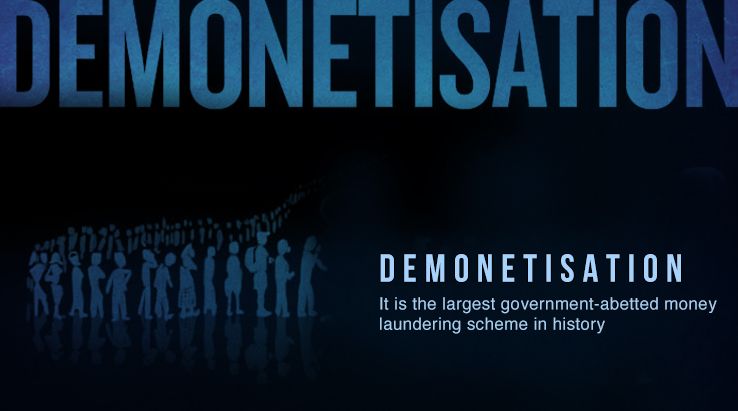
On November 8th, 86% of India’s currency was nullified in an effort to clean out “black money” and “counterfeit notes”; this effort resulted in a massive disruption to the existing social, political and economic functions of the world’s second largest emerging market. All 500 and 1,000 rupee notes were instantaneously voided, and a 50-day period ensued where the population could (ideally) redeem their cancelled cash for freshly issued 2,000 and later 500 rupee notes or deposit them into their respective bank accounts.
In the ensuing days after Demonetization, the public in general was hit quite bad, but it was the poor who took the largest share of pain. The poor and the lower middle-classes that constitute the vast majority of the population, simply did not have the access to structural and cultural resources needed to adapt to such shock economics.
Even the banks, debuted to do all the heavy lifting on the ground, weren’t kept in the loop; ill-equipped for the crisis and unable to make sense of an outlandish government order, they still managed to do a remarkable job despite not even having an adequate supply of new notes to balance out the nullified currency. With 86% of existing cash that was in circulation having been demonetized, the Indian Economy came to a sudden, screeching halt.
Trade across all facets of the economy was disrupted, and cash-centric sectors like agriculture, fishing, and the voluminous informal market, were virtually shut-down. Many businesses and livelihoods went under completely, not to mention the economic impact to the country when you have millions of productive people just standing in line for hours and hours, just to exchange or deposit cancelled banknotes, rather than working or running their businesses.
Even the undeclared emergency in the newsrooms failed to contain the news spreading like wildfire throughout India: Demonetisation was a colossal and completely avoidable failure and the largest government-abetted money laundering scheme in history.
Demonetisation failed to curb black money as 99% of the withdrawn 500 and 1000 rupee notes were returned, according to the RBI. This was expected as black money isn’t usually stored in currency, but property, bullion and more easily convertible currency like dollars. Thus, the dichotomy between ‘Black Money’ and ‘Black Wealth’: one is a flow variable and one is stock variable. And no amount of demonetization can bring about any change in stock variables. The claims of unearthing large amounts of black money are unfounded and based on a naïve and uninformed view of what actually constitutes black money.
Furthermore, the announcement failed to stem any sort of terror attacks and insurgency as there were 23 more attacks in Kashmir alone after the announcement. There were numerous reports of insurgents caught with large hordes of new currency on the Indian border.
The extent of circulation of counterfeit notes in the Indian economy is exaggerated. A special report carried out by the Indian Statistical Institute (ISI), Kolkata, found out that the circulation of counterfeit currency was about Rs. 400 crore i.e. a mere 0.022%, of the total notes in circulation; simply not worth the 2% damage to India’s GDP growth.
It failed to produce a cashless economy as whatever rise in e-commerce sales took place during that period, returned to the same growth trend-line as before in a matter of few months, when cash supply was finally normalised. Considering the extent of the Indian unorganized sectors, it was simply illogical to even attempt digitalisation before creating an alternate payment infrastructure.
As a result of this catastrophic move, 3 lakh crore rupees in national income was lost; a conservative estimate given the informal cash-based economy accounts for nearly 50% of GDP or 65.25 lakh crore rupees. Some bank managers grew rich from the haircuts they took on people’s hard-earned money, quickly forming a sophisticated and organised money laundering racket. Meanwhile, a 115 people died as a direct result of the ‘note-bandi’—almost all were poor. Even after the supportive mainstream media declared demonetisation a failure, PM Modi has still not been able to bring himself to condole with their bereaved families or pay them any compensation for the loss of in many cases, their primary breadwinners.
The demonetisation move represents not just a faulty economic policy but also holds high potential for indiscriminate state surveillance, violation of privacy and abuse of civil liberties, with the replacement of cash payments with digital payment systems. With big data analytics growing bigger day by day, personal data of private citizens have turned into commodities on the grey markets, that may result in a breakdown of basic social-contracts and trust between the state and its citizens.
The end truth is, the Prime Minister expected to make a tidy profit of 4 lakh crores from dispossessing those who weren’t able to exchange their notes. Instead, 21,000 crore rupees of our tax money was squandered on printing notes, while only 16,000 crores were left unclaimed.